
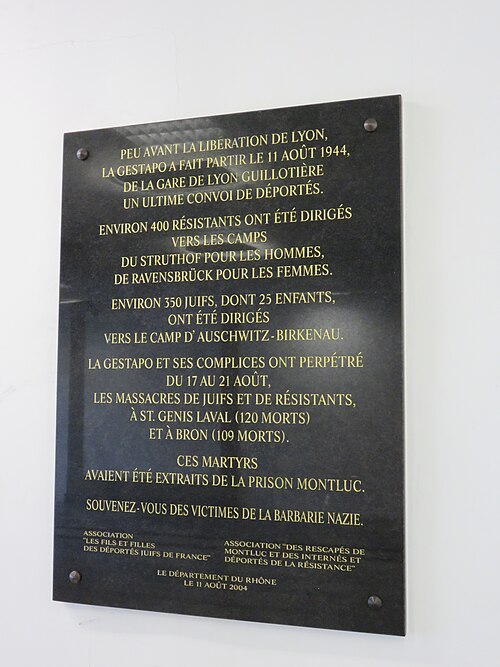
In memory of the victims of the Deportation, SNCF has for many years been committed to having commemorative plaques installed at stations from which deportation convoys departed. Placed at the very sites where men, women and children were gathered before their departure, these plaques help to durably inscribe their history in public space and in collective memory.
They recall that French stations were, depending on the period and the region, transit points towards internment, concentration or extermination camps. Each plaque thus provides a local anchor for the history of the Deportation and pays tribute to the victims, while enabling present and future generations to better understand the events that took place at these sites.
These plaques notably commemorate departures:
- to internment camps, as at Latour-de-Carol (Pyrénées-Orientales), where a plaque was unveiled in 1993. The station stands as a site of memory recalling the journeys of men and women interned there before some of them were transferred to other camps or deported;
- to concentration camps, with plaques installed notably at Fréjus (Var) and Nanteuil-Saâcy (Seine-et-Marne) in 1993, at Toulouse in 2004, at Merrey (Haute-Marne) in 2005, as well as at Compiègne (Oise). This last site holds a particular place in the history of the Deportation in France: Compiègne-Margny station was notably used to carry numerous deportation convoys from the Compiègne camp to the Nazi camps;
- to extermination camps, with commemorative plaques installed at Langeais (Indre-et-Loire) as early as 1949, at Montélimar in 1976, at Paris-Gare de l’Est in 1992, at Lyon-Perrache in 2004 and at Longages-Noé (Haute-Garonne) in 2006, as well as at Paris-Austerlitz and at Compiègne.
Over the decades, these initiatives have thus multiplied the sites of memory across the country. From the station of a small town to those of major French cities, these plaques concretely recall the existence of the convoys and the fates of those who were deported. They give a local dimension to a national and European history, and turn the station, a place of everyday passage and mobility, into a space for remembrance and reflection.
Installing a plaque is thus not just a commemorative gesture: it contributes to the preservation of the traces of the Deportation, to the recognition of the victims and to the passing on of their history. By marking these events at the very sites where the convoys were formed or passed through, it helps to keep alive a memory that remains closely linked to the history of the French railway.