In France, the school curriculum includes three points at which young people are confronted with the Second World War, the Deportation, the Holocaust and collective memory: at the end of primary school, middle school and secondary school. Memory work aimed at young people can take various forms, including artistic approaches. SNCF has supported educational projects based on testimonies of the deportation and drawing on theatre workshops, combining stage performances with educational encounters. Working in cooperation with teachers within schools makes it possible to build a new way of approaching curriculum themes with pupils, drawing on these performances.
“Qui rapportera ces paroles ?”
SNCF supported the creation of the play and the educational programme.
The Angers-based company OeilduDo worked with secondary school pupils on Charlotte Delbo’s tragedy “Qui rapportera ces paroles ?” (« Who will carry these words? »), which the company staged for the first time on 8 March 2013, as part of the celebrations marking the centenary of the writer’s birth.
During the Second World War, Charlotte Delbo was a Resistance member within the Politzer group, where she was notably responsible for producing “Lettres françaises”, a clandestine literary publication. Charlotte Delbo and her husband were arrested on 2 March 1942. He would be shot at Fort Mont-Valérien. She was deported on 24 January 1943 to Auschwitz-Birkenau, along with 229 other women, most of them, like her, involved in the Resistance. She was then sent to the Ravensbrück camp in January 1944, from where she was freed by the Red Cross in April 1945. Only 49 deportees from her convoy would survive by 1945.
Written in 1966, the play recounts the daily life of the 230 women in the hell of the camp, who are, at the start of the performance, represented by 23 female characters. By the end, only two remain, to “carry these words”.
The company OeilduDo, directed by Virginie Brochard, invited pupils to discover the words of a woman who, having lived through the experience of the camps, bears witness to their horror but also to the courage and solidarity of the deportees. A staged reading of “Ondine, à deux voix humaines” (« Ondine, in two human voices »), Charlotte Delbo’s farewell letter to her husband, was also created.
“Haïm, à la lumière du violon”
SNCF supported the performances of the show in December 2012 and January 2013, at the Salle Gaveau in Paris, as well as the educational programme.
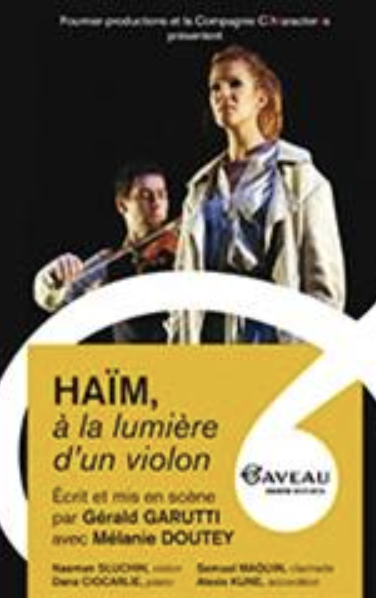
“Haïm, à la lumière d’un violon” (« Haïm, in the light of a violin ») is a play created by the company C(h)aracteres about the life of Haïm Lipsky, a Polish Jew born in Lodz in 1922 into a working-class family, who escaped death at the Auschwitz camp thanks to his talent as a violinist. He emigrated to Israel after the war and gave up music. His children and grandchildren would take up the instrument in his place.
Written and directed by Gérald Garutti, the play combines narration and music, performed in particular by Haïm Lipsky’s own grandson, a violinist.
With his theatre company, Gérald Garutti developed, from this show, an educational programme for secondary school pupils in Aubervilliers (Seine-Saint-Denis), where the company is based: around ten encounters with the director and the artistic team in the middle and secondary schools of Aubervilliers, and work with the teachers of four classes within these schools, with pupils who had been able to attend the performance.
A “privileged” little girl
SNCF was a partner of the company for the performance schedule and the educational programme.
Francine Christophe was eight and a half years old in July 1942, when she was arrested with her mother, because they were Jewish. Interned in several French internment camps, they were deported on 2 May 1944 along with other women and children of Jewish prisoners of war, who were held in Oflags in Germany. For this reason, these women and children escaped Auschwitz but were sent to the Bergen-Belsen concentration camp with hostage status, to serve as bargaining chips for the Nazis.
A “privileged” little girl, Francine Christophe would use this adjective ironically in the account she wrote on her return and published under this title fifty years later (Une petite fille privilégiée. Une enfant dans le monde des camps, 1942-1945 (« A privileged little girl. A child in the world of the camps, 1942-1945 »), Paris, Éditions de l’Harmattan, 1996).
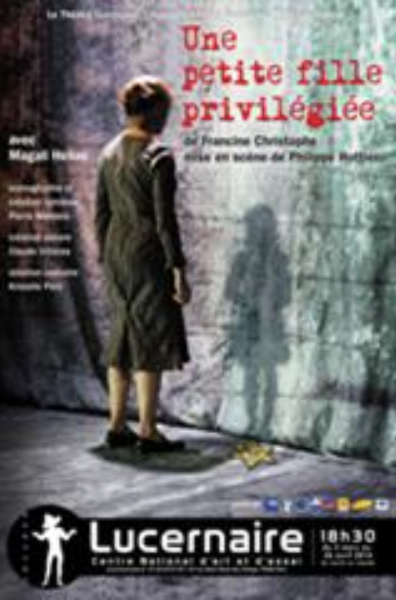
A stage adaptation of the original text was produced by the TRAC company, directed by Philippe Pottier. It was performed in 2014 at the Palais des Rois de Majorque in Perpignan before more than 900 middle and secondary school pupils, during memorial events on the Deportation. The Théâtre du Lucernaire, in Paris, gave 40 performances between April and May 2014.
The TRAC company put forward an educational project based on this show, working with final-year middle school and final-year secondary school classes in Languedoc-Roussillon and Île-de-France. A programme specially aimed at school audiences was established.