The Bachelier report represents a decisive stage in the study of SNCF under the Occupation. Its significance extends well beyond the field of railway history alone, as it illustrates how archives can be used to address sensitive historical questions. Drawing on a critical analysis of sources and a rigorous scientific methodology, this study helped renew understanding of SNCF’s role during the Second World War and remains today an essential reference for researchers working on this period.
A research context shaped by historical debate
During the 1990s, the question of SNCF’s role during the Second World War generated extensive debate, both in academic circles and in the public sphere. The questions raised concerned in particular the company’s involvement in transporting deportees, as well as the respective responsibilities of the French State, the German authorities and the railway company. It was in this context that SNCF entrusted historian Christian Bachelier with an in-depth study aimed at establishing a state of knowledge based on archival analysis.
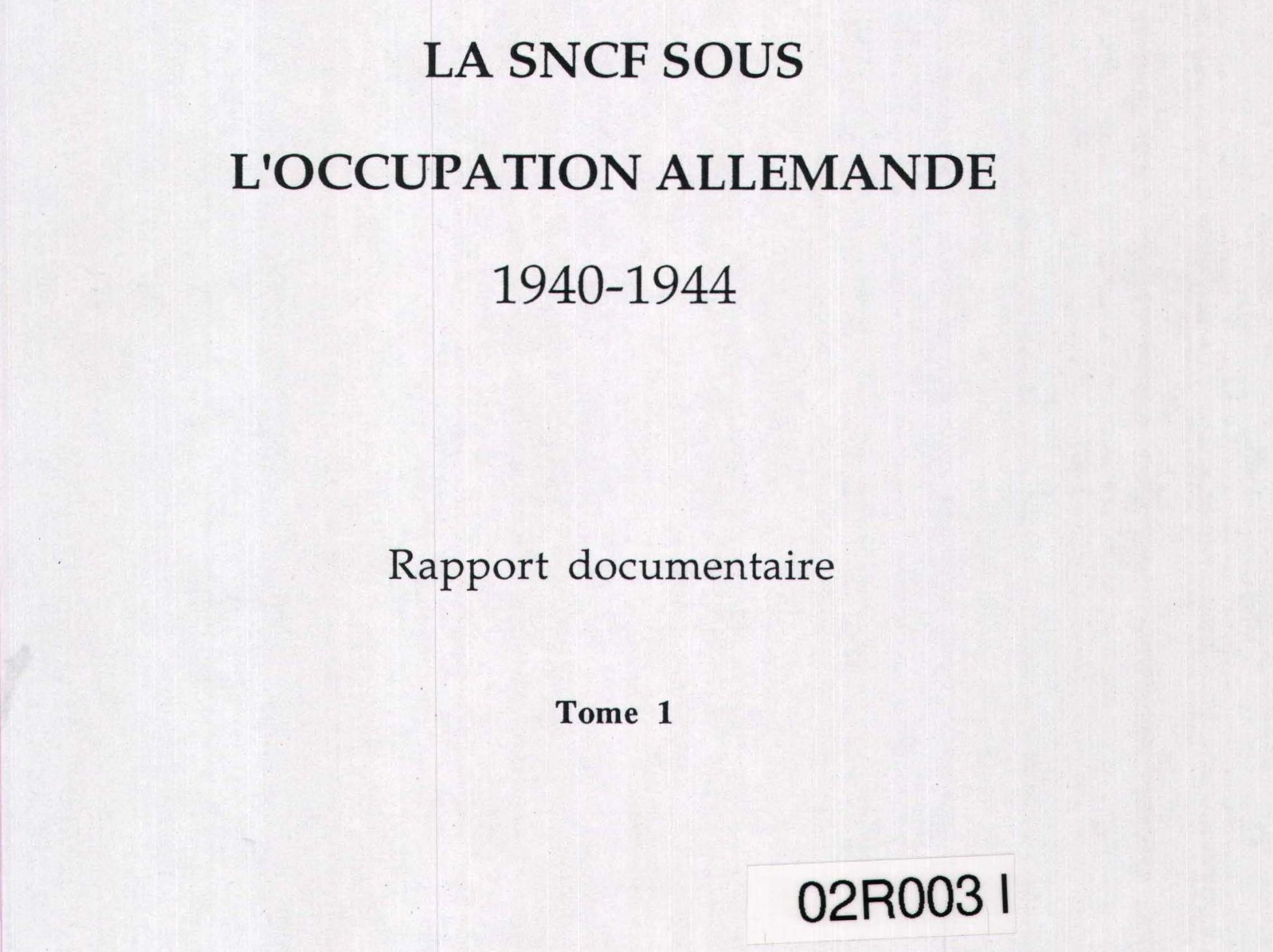
Published in 1996 under the title La SNCF sous l’Occupation allemande (1940-1944), this work is one of the first large-scale studies devoted exclusively to the company’s operations during this period. It follows a historical approach based on the critical use of documentary sources and a commitment to presenting the facts within their political, administrative and technical context.
A methodology grounded in the use of archives
The report’s originality lies in the importance given to archival sources. The study is based on the analysis of a particularly extensive body of material comprising archives produced by SNCF, but also documents from French administrations, the German authorities and various public services. This documentary diversity makes it possible to cross-reference information from several different archive producers and reduce the risks of interpretation tied to a single source.
The method used draws on the principles of historical and archival research. Each document is examined according to its context of production, its author, its administrative purpose and the circumstances in which it was preserved. This approach makes it possible to assess the significance of the information contained in the archives while taking into account any gaps. The analysis thus favours an approach grounded in documentary evidence rather than isolated testimonies or after-the-fact interpretations.
The report’s main findings
The research carried out by Christian Bachelier highlights the complexity of how SNCF operated during the Occupation. The company functioned in an environment marked by strong constraints imposed by the occupying authorities, who controlled a significant part of the organisation of rail transport.
The report shows that SNCF operated the network technically within a heavily regulated framework, while decisions relating to deportation policy fell to the German authorities and the French State’s services. This distinction between political decision-making and technical execution is one of the study’s main contributions, without obscuring the company’s involvement in the physical organisation of the convoys.
The analysis also sheds light on the heterogeneity of individual behaviour within SNCF. The archives reveal a diversity of situations, ranging from compliance with administrative instructions to acts of resistance, sabotage or assistance to persecuted populations. This diversity calls for avoiding any uniform interpretation of the role of the company and its employees.
Scientific contributions
Beyond its historical conclusions, the Bachelier report stands as a remarkable example of archive-based research. It demonstrates that documents produced in the course of administrative activity can be used to reconstruct complex events, provided they are subjected to rigorous critical analysis.
The study also underlines the fundamental principles of archival science: respect for the context of production, identification of archive producers, cross-referencing of sources, and awareness of documentary gaps. It is a reminder that an archival document is not absolute proof but a piece of information whose value depends on its context and on cross-checking it against other documents.
This work also contributed to a better understanding of SNCF’s archival holdings relating to the Second World War. The research undertaken on this occasion helped with the classification, description and promotion of numerous documents now accessible to historians, researchers and the general public.
The study’s limitations
Like any historical research, the report has certain limitations. Its conclusions are based on the archives that have survived, while some collections have been lost, destroyed or remain incomplete. This reality calls for a degree of caution in interpreting the findings, and is a reminder that the absence of a document cannot be equated with the absence of a fact.
Furthermore, advances in historical research since the report’s publication have enriched understanding of the period, thanks to the opening of new archival collections and the development of new research questions. The Bachelier report nevertheless remains an essential reference, one that continues to inform work devoted to SNCF during the Second World War.
Consult the report
« La SNCF sous l’Occupation allemande (1940-1944) ». Christian Bachelier, Paris, IHTP-CNRS (1996), a documentary report in 5 volumes.