Through acts of resistance, German repression and personal sacrifice, French railway workers paid a heavy price during the Second World War. A look back at the lives of the women and men who fought against the Occupation.
Resistance, repression and the memory of railway workers
Subject to German wartime laws, railway workers were closely watched: acting against the occupiers was extremely risky. An accusation of resistance activity could mean a death sentence. In 1941, the German military command in France also introduced a hostage policy. During 1943, as attacks on the railways and sabotage at railway facilities increased, this form of collective punishment was increasingly imposed on railway workers. The Gestapo systematically linked sabotage to hostage taking. Railway workers were taken hostage and sometimes shot, even when their links to the Resistance had not been established.
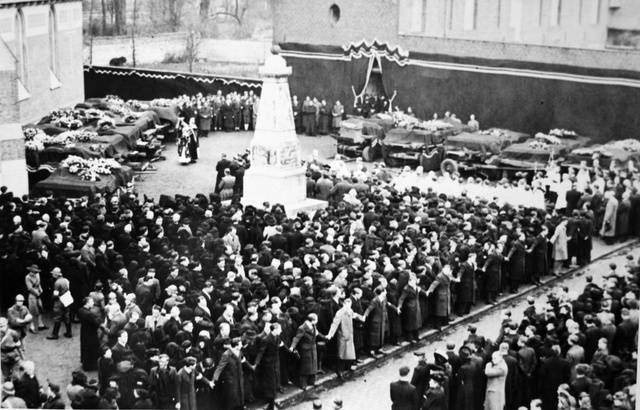
From May to August 1944, repression reached its peak during the operations that prepared for and followed the Allied landings. Arrests of railway workers followed by deportation declined, probably as rail traffic collapsed, while the number of those shot peaked at 75 in August 1944. This was a period of summary executions and massacres. Reprisals sometimes became outright massacres. On the night of 1st to 2 April 1944, an act of sabotage near Ascq station in northern France struck one of 61 trains carrying the 12th SS Hitler Youth Division to Normandy. A Nazi officer aboard the train immediately ordered a sweep of the village. Dozens of civilians were rounded up and murdered beside the railway line. The massacre claimed 86 victims aged 15 to 75, including 22 SNCF employees.
Railway workers took part in the liberation of France. In all, more than 2,200 railway workers, women and men, most of them Resistance members or victims of reprisal roundups, were murdered, executed by firing squad, shot dead, or disappeared in prison or after deportation.
The final letter of a railway worker executed by firing squad
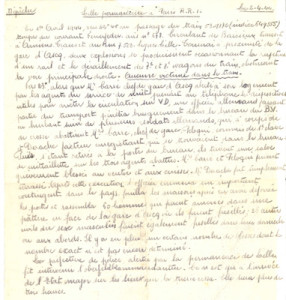
Eugène d’Hallendre, a technical inspector in Arras (Pas-de-Calais), was responsible for checking the condition of the railway tracks. His work gave him freedom of movement, which he soon used for clandestine activities. He wrote leaflets and left them in stations and trains. He also distributed the underground newspaper La Voix du Nord and helped downed Allied airmen. Eugène d’Hallendre also gathered intelligence on German military transport and facilities. He was arrested and executed by firing squad on 27 December 1943. Here is the letter he wrote to his family and loved ones on the day of his execution.
My dear parents,LOOS, 27 December 1943
I must die today; I go in good health and with courage. I wish to be buried in LA MADELEINE after the war.
I want you all to be as brave as I have been.
May my wife and my dear son Edgard, both innocent, also remain strong in the face of fate.
May Edgard finish his studies and become a good citizen, marry and raise a large family as a good Christian, as he has always been.
I leave you now, embracing you all warmly, as well as all my friends.
I forgive everyone, and may God have mercy on me.
Your loving son. E. D’HALLENDRE
P.S. – Thank you to all the friends who kindly looked after my situation. Warm kisses to my dear wife and my beloved son.
2nd P.S. – Please ask the parish priest of LA MADELEINE to say a Mass for my soul and thank the Mayor for the lovely Christmas parcel I was still able to enjoy. The content of the quotation
The collective participation of railway workers in the Resistance and the Liberation, together with their suffering and individual sacrifices, was commemorated regularly from 1944 onward. These commemorations, along with railway workers’ contribution to reconstruction, strengthened the image of a profession united in resistance. René Clément’s film La Bataille du Rail, released in France in 1946, holds a prominent place in collective memory and played a central role in shaping the heroic image of the railway worker in the Resistance. That image became more complicated in the 1980s, when SNCF faced scrutiny over the railways’ role in deportations to the Reich.