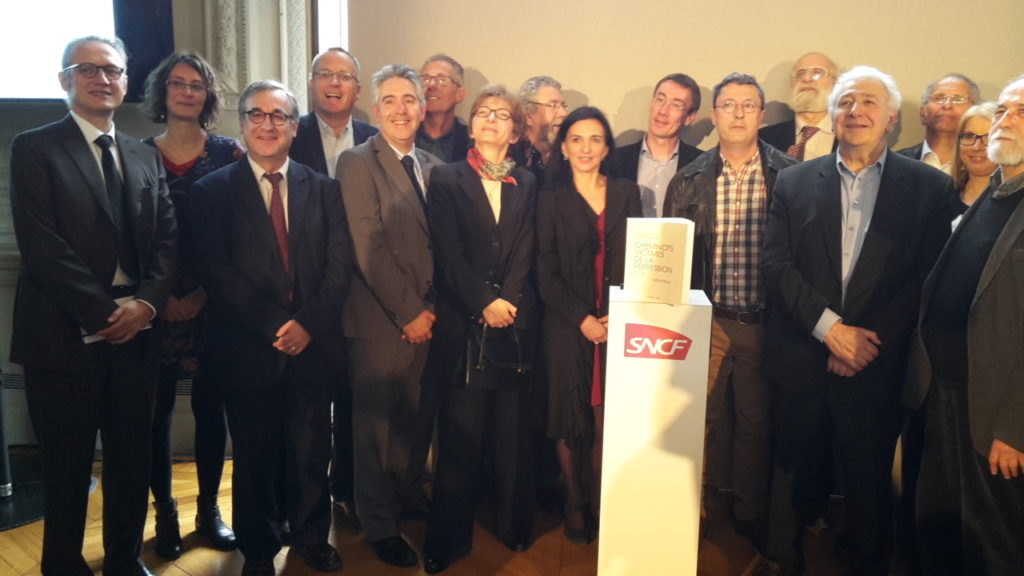
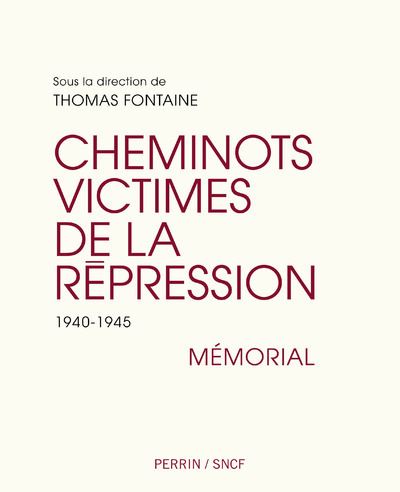
In April 2017, SNCF published, with Rails & histoire and Éditions Perrin, Cheminots victimes de la répression, 1940-1945. Livre mémorial, under the scientific direction of historian Thomas Fontaine. The result of nearly five years of research, this 1,764-page work is both a memorial honouring those who died and a tool for historical understanding.
A memorial to 2,672 life stories
The book brings together the biographical entries of 2,229 current or former SNCF employees who fell victim to the repression carried out in France between 1940 and 1945 by the German authorities and the Vichy regime. These men and women met different fates: some were executed after being sentenced or shot as hostages, others were gunned down or massacred, died in prison or in deportation, or died shortly after returning from the camps. The diversity of these life stories reflects the many forms repression took and the range of situations railway workers faced during the Occupation.
The scope of the census
The book is not a census of all railway workers who died during the Second World War. Its scope rests on a precise criterion: victims of repressive measures, meaning people whose death was linked to their arrest, sentencing, execution, deportation or to reprisals. Railway workers killed in bombings or strafing attacks, as well as soldiers who died while serving in 1939-1940, are therefore not included in this first group.
A second part, however, extends the memorial to the 443 employees who fell in the fighting of the Liberation, notably railway workers who joined the maquis and died bearing arms. In total, the book thus records the names and life stories of 2,672 people, linking their professional history to their experience during the war.
Mémorial
Work grounded in the archives
The creation of this memorial is based on extensive research carried out between 2012 and 2016. Researchers cross-referenced sources of different kinds in order to establish, for each person, their genuine connection to the railway world and the circumstances of their death.
Cross-referenced sources to document each life story
SNCF’s archives were one of the main sources for this research, notably career and pension records held by the Centre national des archives du personnel, a SARDO entity. They were cross-checked against the collections of the Service historique de la Défense, family archives, commemorative plaques and existing work devoted to the Resistance and repression.
More than 3,500 files were thus examined and verified. The entries retained underwent research and cross-checking of sources so as to document as precisely as possible each person’s professional history and the circumstances of their death. Each entry is accompanied by references to the archives used to establish the information presented.
A collective effort
This collective effort was coordinated by Rails & histoire and brought together historians, archivists, researchers and figures from associations and memorial organisations. The project committee notably included SNCF’s Service Archives Documentation, the Cercle généalogique des cheminots, the Institut d’histoire sociale CGT Cheminots, Rail & Mémoire, the ANCAC, the Fondation pour la mémoire de la Déportation, La Coupole, Mémoire Vive and the Service historique de la Défense. In total, 39 authors contributed to the book under the direction of Thomas Fontaine.
A memorial to bring these stories to light
Beyond cataloguing the victims, the book’s ambition is to restore a history and a face to each of them. The entries recount individual life stories, their commitments, their professional activity, the circumstances of their arrest and death, and, where the sources allow, the traces left in the archives and in the memory of their loved ones.
This approach through individual life stories places the victims within their professional and personal history and, through individual trajectories, helps build a better understanding of the diversity of situations experienced during the Occupation.
The book thus follows an approach that is both historical and memorial. It adopts a perspective grounded in professional identity and complements the major memorial works devoted to the victims of the Second World War. It is also a resource for researchers, teachers and all those wishing to deepen their understanding of the history of railway workers and SNCF during the war.
A 55-page introduction presents the historical context and the methodological choices of the project. A glossary, a select bibliography, an index and a presentation of sources round out the book and make it a reference tool for researching and passing on this history.
Through the scale of the research carried out and the attention paid to each individual life story, Cheminots victimes de la répression, 1940-1945 stands today as a reference work for understanding the railway workers who fell victim to repression and to the fighting of the Liberation. It helps inscribe their names and their stories in collective memory and, drawing on the archives, pass on a well-documented history of the Second World War.