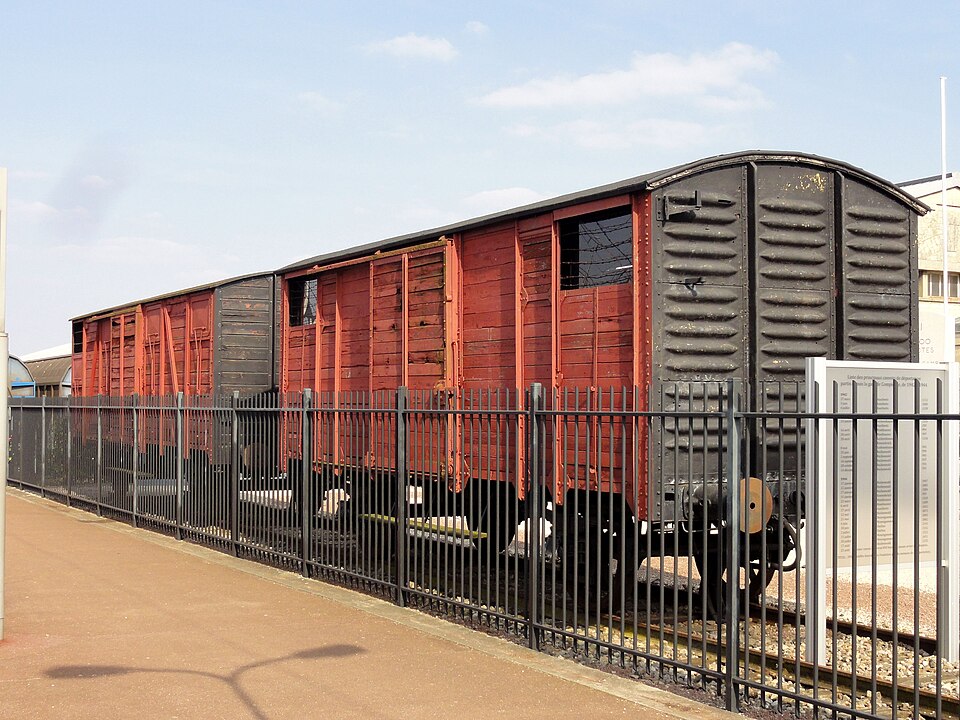
In 2007, SNCF took part in installing a memorial wagon at Compiègne-Margny-lès-Compiègne station, in the Oise département. From March 1942 to August 1944, nearly 50,000 people were deported from this station.
Margny-lès-Compiègne station, a major site of the deportation
The first convoys of Jews left Compiègne-Margny on 27 March and 5 June 1942, bound for Auschwitz. On 6 July 1942, the first large convoy of “political” detainees, mostly communists, also left for Auschwitz. From January 1943 onwards, deportation for repression took on a massive scale. Alongside smaller-scale transports to German prisons and camps, there were 28 large convoys, each carrying between one and two thousand deportees, bound notably for Auschwitz, Buchenwald, Dachau, Mauthausen, Natzweiler-Struthof, Neuengamme, Ravensbrück for women, and Sachsenhausen, as well as their many satellite camps.
Before their departure, most of these deportees were interned at the Compiègne-Royallieu camp, located about four kilometres from the station. Opened by the German authorities in June 1941, the camp was one of the main sites for interning and assembling people destined for deportation from France.
Deportation for repression affected around 88,000 people, according to the research of the Fondation pour la Mémoire de la Déportation. It mainly struck people arrested for their Resistance activities, their views, or remarks considered hostile by the German authorities and their collaborators. It also included hostages, people arrested during round-ups, and ordinary-law prisoners. The conditions of detention and deportation were particularly deadly: the mortality rate among repression deportees is estimated at more than 40%.
A site of memory at the heart of the station
The Mémorial du wagon de la Déportation was unveiled in March 2013 on a platform made available by SNCF and listed as a historic monument. The site now displays two wagons and offers audiovisual testimonies from former deportees, putting faces and voices to the history of the deportation.
Open to the public by appointment, the memorial welcomes in particular many school groups. It is thus a place for passing on history and raising awareness, allowing younger generations to understand the history of the deportation from Compiègne and the role played by the station in the Nazi system of persecution and deportation.