
The Armistice Convention
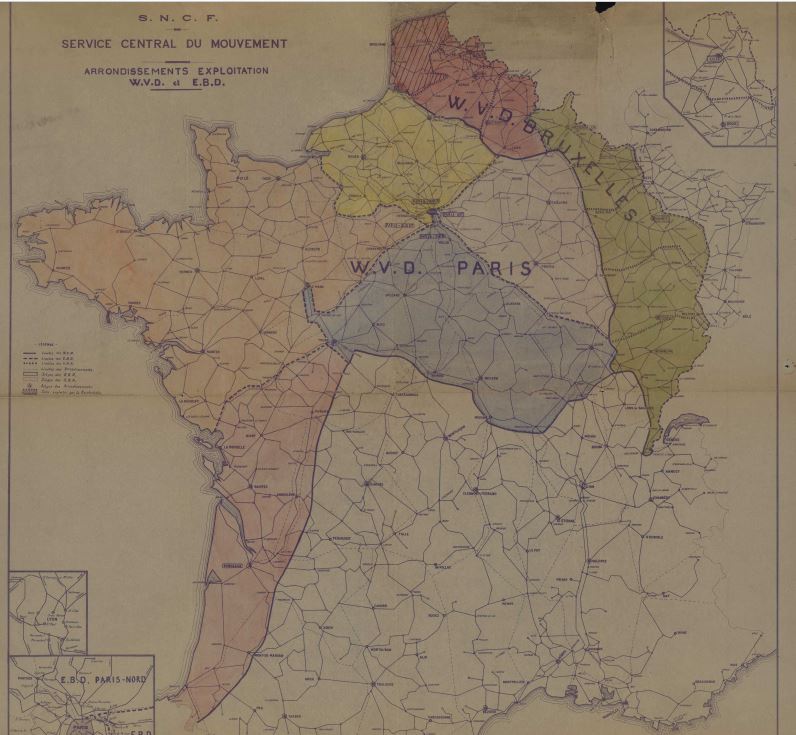
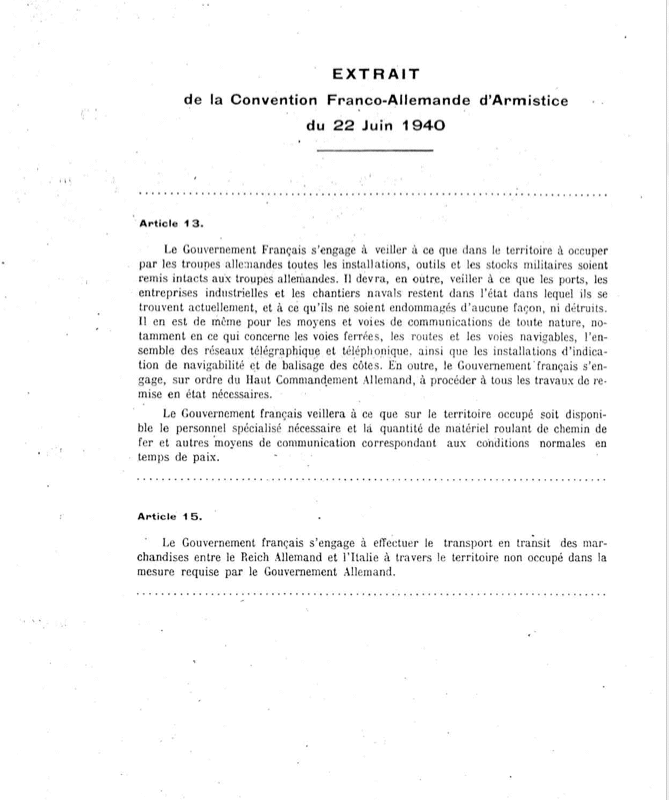
On 22 June 1940, Germany and the French government of Marshal Pétain signed the armistice convention at Rethondes (Oise). France was then divided into an occupied zone, placed under the authority of the German authorities, and an unoccupied zone, administered by the Vichy government. The demarcation line separated the two zones until German troops crossed it in November 1942. About two-thirds of the rail network lay within the occupied zone.
The armistice convention governed the operation of the railways. Its articles 13 and 15, along with their implementing provisions, placed the rail network and the specialised staff needed to operate it at the « full and complete disposal » of the German head of Wehrmacht Transport. He could take the measures necessary for operation and traffic and had oversight of the rules governing transport.
SNCF, created in 1938, had to carry on its activity within a profoundly disrupted framework from then on. The network continued to be operated by French railway workers, but under the surveillance and demands of the German authorities in the occupied zone, while the Vichy government retained its authority in the unoccupied zone until November 1942. This arrangement placed the company at the heart of a system of constraints stemming at once from the defeat, the Occupation, the armistice and the policy pursued by the Vichy government.
Railway workers under constraint
With about 500,000 employees, SNCF was in 1940 one of the largest French companies. In the occupied zone, the Wehrmachtverkehrsdirektion (WVD), the German army’s transport directorate, set up in Paris on 15 July 1940. It exercised direct control over the operation of the network. Three days later, the German Minister of Transport, Julius Dorpmüller, travelled to Paris and gave a speech at Gare de l’Est before German railway workers.
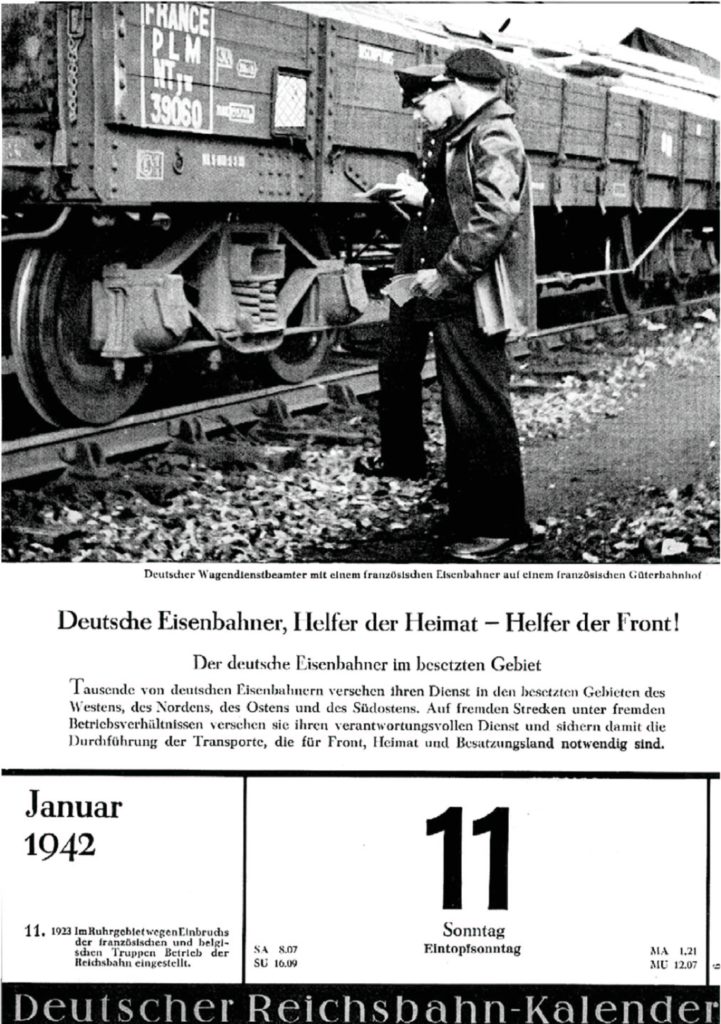
The WVD imposed the presence of German railway workers in stations, depots and the main operational sites. French railway workers continued to run the trains, but transport requested by the occupying forces was given decisive priority. By the end of 1940, nearly 10,000 German railway workers were present on the French network; there would be more than 30,000 by the time of the Landings. SNCF’s organisation was adapted so that each level of its hierarchy was placed under the surveillance of a corresponding German structure.
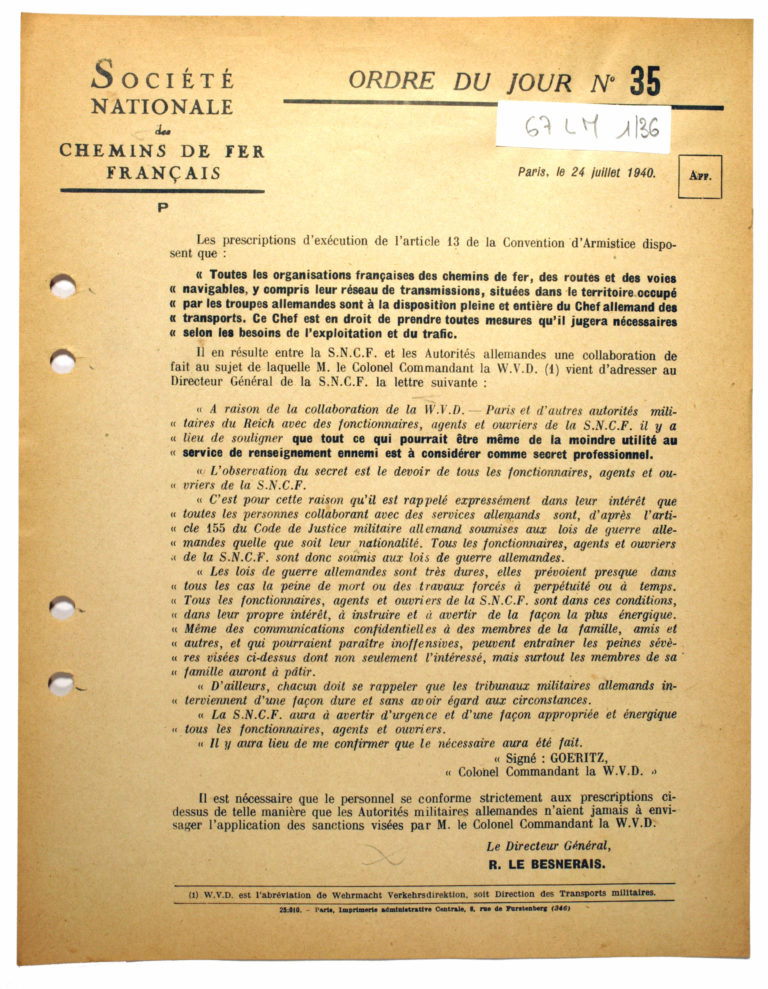
German directives reminded French staff of the reality of this authority. In order of the day no. 35 of 24 July 1940, the WVD commander stressed that the French railway organisations were at the « full and complete disposal » of the German head of Transport and recalled the sanctions faced by those who contravened the occupying forces’ requirements.
This surveillance was accompanied by growing requisitions.
Requisitions of equipment and personnel
SNCF had to keep trains running between the different zones, while meeting the demands of the occupying forces. Requisitions covered both rolling stock and staff. In autumn 1940, SNCF was thus compelled to supply the Reichsbahn with 2,000 locomotives and 85,000 wagons.
The German authorities also demanded railway workers. In February 1941, the Reichsbahn requested in particular 5,000 train drivers and 6,000 workshop workers familiar with French equipment. SNCF then sought to meet these demands, notably by calling for volunteers and training staff recruited from outside the company.
At the same time, the company’s workforce was shrinking as a result of the war and policies of repression. Some railway workers were prisoners of war, others were sanctioned or dismissed under the policy pursued by the Vichy government. The antisemitic laws also led to the exclusion of Jewish railway workers from the company.
From 1943 onwards, the situation deteriorated further. Bombing, strafing and sabotage progressively disrupted the network, while German military needs increased. As the Reich’s military situation worsened, the German authorities tightened their grip on rail operations.
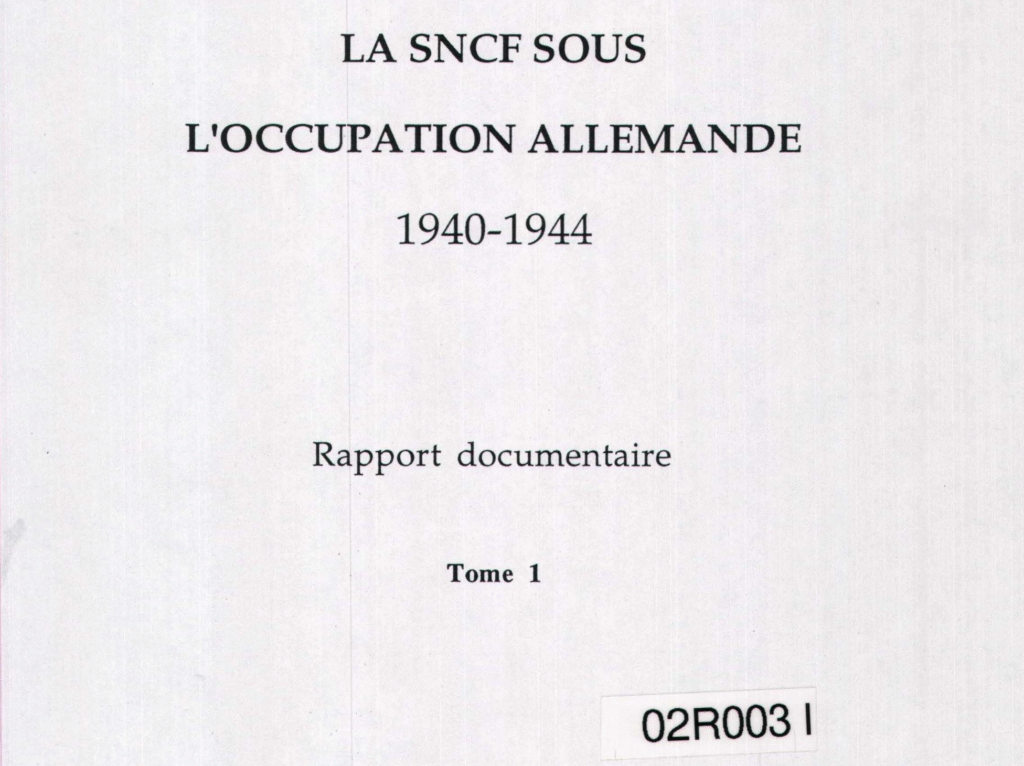
Deportation for Repression and the Holocaust in France
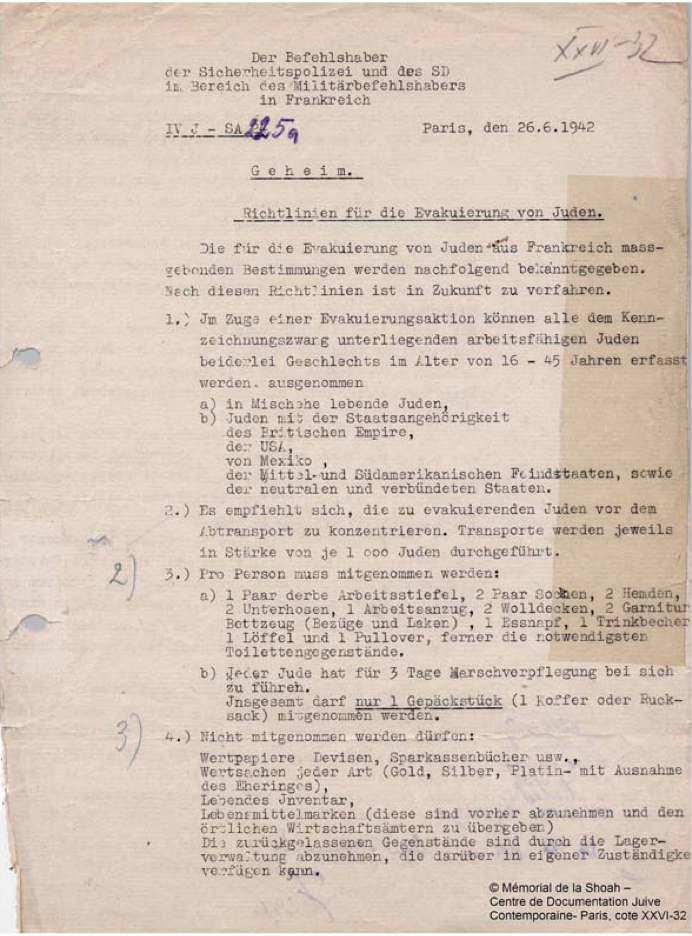
From 1942 onwards, the French rail network was used for the deportations organised by the German authorities, with the participation of the French authorities in carrying out antisemitic persecution and repression.
The deportation of the Jews of France began on 27 March 1942, with the departure from Compiègne of the first convoy bound for Auschwitz. A second convoy also left Compiègne on 5 June 1942. Departures then took place mainly from Le Bourget-Drancy, then, from 1943 onwards, from Bobigny. In total, 75,721 Jews were deported from France between 1942 and 1944, including about 11,400 children.
Deportation for repression also grew in scale. On 6 July 1942, a first large convoy of detainees, mostly communists, left Compiègne for Auschwitz. From 1943 onwards, Resistance members and others arrested as part of the repression were deported in growing numbers to the Reich’s concentration camps, notably Buchenwald, Dachau, Natzweiler-Struthof, Mauthausen, Neuengamme, Ravensbrück and Sachsenhausen.
These transports were organised as part of the German system of repression. SNCF operated the railways under the conditions imposed by the occupying authorities, while the arrests, internments, the forming of convoys and the deportation itself were the responsibility of the German authorities and, in some cases, the French authorities who took part in these operations.
The control exercised by the German authorities over transport was particularly tight. Despite the growing difficulties of rail traffic, bombing and sabotage, they sought to keep the deportation convoys running until the summer of 1944.
This period was also one of growing commitment by many railway workers to the Resistance. Intelligence gathering, helping people being sought, escapes, passing on information and sabotage progressively grew in scale. More than 2,200 railway workers fell victim to the repression between 1940 and 1945: mostly Resistance members and victims of reprisals, they were murdered, shot, gunned down or died in prison or in deportation.
The history of SNCF between 1940 and 1944 is thus that of a company subject to the constraints of the Occupation and placed under the surveillance of the German authorities, but also that of its staff: some fell victim to the repression, while others progressively committed to the Resistance. This history must be understood by distinguishing between the constraints imposed on the company, the decisions taken by its leaders and supervisory authorities, the demands of the occupying forces, and the individual commitments of railway workers.